Ingredients
Method
- Preheat oven to 400°F.
- Sift your flour to ensure a light cracker.
- In a food processor, mix 1 cup of the flour, 1/2 teaspoon salt and the oil. Add 3 tablespoons water and mix well.
- Gradually add more water, mixing after each addition, until the mixture forms a compact ball. If it seems too sticky to handle, add a touch more flour and pulse. If it is too dry, sprinkle a little more water and pulse. Various factors, like altitude and humidity, affect this, so use your good judgment.
- Sprinkle your work surface (or parchment paper) with some of the remaining flour. To prevent sticking, dust your hands and the rolling pin with a little more flour. Press and roll the dough to about 1/8 inch thickness. If the dough is too dry to roll out, return it to the food processor and add a little more water.
- Try to get the dough really uniform. Setting two 1/8 inch thick wooden dowels on either side of the dough so that the rolling pin eventually rides over the top of the dowels like rails is a good trick.
- Place the rolled-out dough on a baking sheet (or cooking stone) dusted with a little flour or cornmeal. If you've used parchment paper, transfer the dough and parchment paper directly to the baking sheet.
- If you like, take a serrated edge and press serrations into the dough: squares, rectangles, triangles, or whatever. A clean hair comb works great for this, by the way. This will make it easier to break the crackers once baked.
- Place in the preheated oven and bake for 10 to 15 minutes, until light brown.
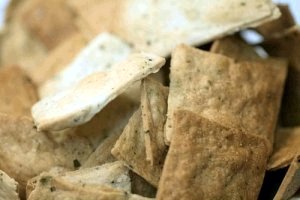
- Let cool on a wire rack and break into pieces. If making several batches, mix another while the first one bakes. Remember that you can re-use the parchment paper several times.
Nutrition
Notes
Traditionally, crackers were baked in stone or brick ovens, so if you have an oven stone, like a pizza stone, you can get fairly close to an artisan style cracker. They also cook up just fine on an ordinary cookie sheet. You'll need a food processor, sifter, parchment paper, and rolling pin.
For grains, I prefer fresh milled whole wheat flour, but just about any flour will do. Use cornmeal, buckwheat or other non-gluten grains for gluten free crackers.
Feel free to experiment with the herbs and seasonings if you don't want just a plain cracker. Some successful combinations might be cornmeal with chili powder, rye with caraway or dill seed, whole wheat with garlic powder, or spelt with poppy or sesame seed.
This recipe was inspired by an original recipe available at Daniel-Fast.com in the Daniel Fast Cookbooks.