
Welcome to Readers Write to Know! I asked you, my readers, what questions they would ask their favorite authors if given the chance, and the authors visiting my blog answered them! This week I’m so pleased to have Karen Mains Procopio as my guest. One of the questions she answered really resonated with me, and I love her description of seeing fifth dimension—the story beneath what everyone else sees. I feel like the exact same thing happens to me – I have just never seen it so perfectly worded. I hope you enjoy her interview as much as I did. Karen is giving away a $10 Amazon gift card – read on to see how you can enter to win!
Tell us a little bit about yourself.
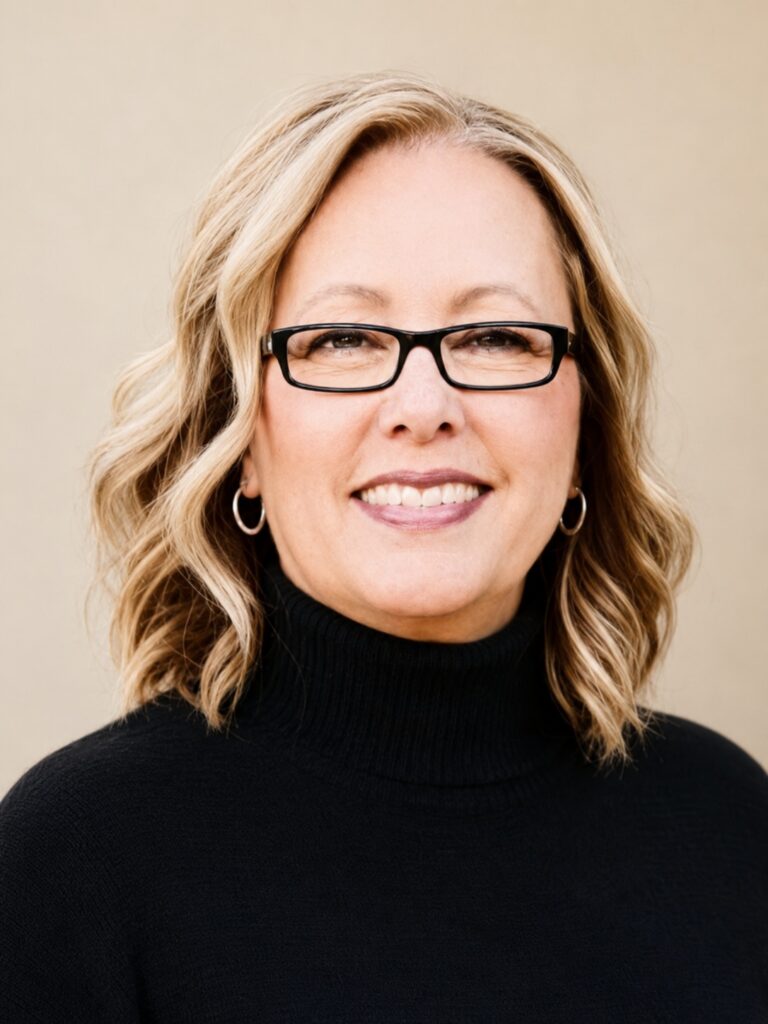
I’m a retired educator, former journalist, wife, mom, Mimi, and now published author living in Arizona with my husband. I spent more than thirty years in education, most of them teaching computer science, but writing has always been a big part of my life. I’ve written for newspapers and magazines, won awards for short fiction, and even had the joy of encouraging young writers as the sponsor of a student novel-writing club. When I’m not writing, I love spending time with my family, reading, traveling, swimming, and riding my bike. Recently, I’ve also resumed playing the clarinet. I grew up in both Michigan and Massachusetts, and my Michigan roots have definitely found their way into my stories.
Tell us about your current release.
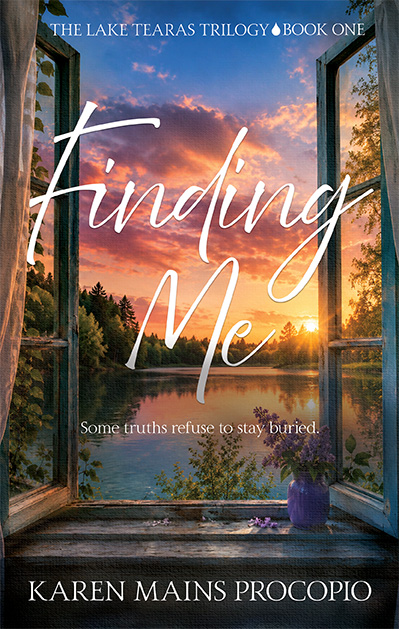
My current release is Finding Me, the first book in The Lake Tearas Trilogy. It’s a contemporary women’s fiction novel about family, buried secrets, forgiveness, and finding your way home. The story follows eighteen-year-old Cate McDermott, who travels to the small lakeside town of Lake Tearas, Michigan, hoping to learn more about the family her mother has kept at a distance for most of her life. What she finds is a grandfather who doesn’t exactly welcome her with open arms—and a past filled with secrets that begin to change everything she thought she knew about her family and herself. The story is told through both Cate’s and her mother Susan’s perspectives, so readers get to see how choices made years ago continue to ripple through the present. At its heart, Finding Me is about mothers and daughters, the complicated ways families love one another, and whether healing is possible when long-buried truths finally come to light.
Do you remember where you were or what you were doing when you started this story?
I remember exactly where I was. It was 2009, and I was sitting beside my daughter’s bed in a pediatric hospital. She was extremely ill, and I spent six weeks there with her, feeling completely helpless and painfully aware that so much was beyond my control. But there was one thing I could control—a story and the characters who lived inside it. So I began to write. What eventually became Finding Me started during those long days at the hospital as a way for me to cope with everything happening around me. The book was originally titled Summer Rain, and at the time, I had no idea that one story would eventually grow into The Lake Tearas Trilogy. Writing gave me somewhere to put all that emotion when I couldn’t change what was happening in the real world. Looking back, it amazes me that something born during one of the most difficult periods of my life eventually became a story I could share with others.
What inspired you to start writing, or did you always want to write?
I’ve always been a writer. I don’t really think of writing as an occupation or even a hobby. It feels like an integral part of who I am, as much a part of me as having blond hair and green eyes. I can’t separate writing from myself any more than I could remove a limb. It’s simply who I am. I’m constantly viewing the world through the lens of storytelling. Sometimes it feels as though I can sense a fifth dimension—the story beneath what everyone else sees. Everything tells a story to me. I notice nuances in people, their struggles, their worries, the things they say and the things they don’t say. Stories have always spoken to me that way. There have actually been times when I wished I could turn it off. I remember praying that God would either open the door for these stories to be published so they might help someone, or take away my desire to write. But the desire never went away. Eventually, I realized that writing wasn’t something I had chosen to do. It was something I had been given to do.
What’s the first major news headline that you can remember, and what do you remember about it?
The first major news event I remember is the day Neil Armstrong walked on the moon in July 1969. It had been a hot summer day, and we’d spent much of it swimming in the pool at my Nonna’s summer house in Massachusetts. By evening, at least twenty of my cousins were there, along with all the aunts and uncles. There must have been forty of us crammed around a little black-and-white television set, constantly shushing one another so we wouldn’t miss anything. I remember watching Armstrong climb down the ladder and step onto the surface of the moon. I can still picture the glare of the sun reflecting off the lunar module. Then he spoke those famous words: “That’s one small step for man, one giant leap for mankind.” We all cheered. I was just a child, but I knew I was witnessing something extraordinary. It felt surreal, and I remember thinking that nothing in the world would ever be quite the same again.
Who was your first screen or musical crush?
Oh, my! I haven’t thought about this one in a while. My first screen crush was Jan-Michael Vincent. I remember watching him in Disney’s The World’s Greatest Athlete and thinking he was the cutest guy I had ever seen. After that, I grabbed every copy of Teen Beat magazine I could find, hoping to catch another glimpse of him. With that blond hair and those blue eyes, my young heart was completely smitten!
What is your personal, most effective way to get past writer’s block?
I don’t struggle with writer’s block the way I used to because I’ve developed a writing plan that gives me plenty of ways to get started. I think of writing in two parts: foundational writing—figuring out what a chapter or scene needs to accomplish—and creative or inspirational writing, which is the actual act of bringing that scene to life. Before I sit down to write, I usually know what I plan to work on that day, whether it’s a particular chapter, a section of a chapter, or even something as specific as dialogue, setting, or description. I used to be much more of a pantser, but I’ve become a plotter because, for me, it’s much more efficient. I use Scene and Sequel along with Michael Hauge’s Six Stage Plot Structure to help shape the story. If I do get stuck, I go back to the character and ask, “What does this character want?” If I’m staring at a blank page, I’ll literally begin by writing, “I don’t know what I want to say,” or, “This is what I think the character is feeling.” Then I start writing from the character’s point of view. Before long, an inner monologue usually begins to emerge, and that often leads me straight into a scene. I use a similar approach when developing characters. I create a personality profile, choose one of the character’s traits, and write a paragraph exploring it. And some of my best dialogue comes when I’m nowhere near my desk. While I’m cooking or driving, I’ll sometimes ad-lib a conversation between two characters and dictate it into my phone before I forget it. So for me, getting past writer’s block is less about waiting for inspiration and more about giving myself enough prompts, questions, and structure that there is always somewhere to begin.
What advice do you have for aspiring writers?
It starts with believing in yourself. Don’t wait for someone else to validate your desire to write or give you permission to pursue it. If writing matters to you, make it happen. Treat it like a career, even if you have another career that pays the bills. I was a teacher for more than thirty years, but I never stopped believing in my ability to tell a story and eventually get those stories out into the world. I started writing The Lake Tearas Trilogy in 2009, often in whatever pockets of time I could find—during lunch breaks, before first hour, or after the school day ended. Sometimes I had only thirty minutes. But thirty minutes a day adds up. Little by little, the story grew. My advice? Set an alarm for thirty minutes and give that time to your story. You don’t have to write an entire novel today. As they say, Rome wasn’t built in a day. And keep learning. Take classes. Attend conferences. Join professional writing groups. Write short stories, poetry, articles—anything that helps you strengthen your voice and sharpen your skills. You don’t know what you don’t know, and there is always more to learn about the craft. Most of all, don’t take rejection personally. That’s much easier said than done, because rejection hurts. But one person’s “no” does not determine your worth as a writer or the value of your story. Keep honing your craft, keep showing up, and keep believing that your words have a place in the world.
Find Karen Mains Procopio online:
Website: karenprocopiowrites.com
Amazon author page: Karen Mains Procopio on Amazon
Facebook: @authorkmprocopio
Instagram: @karenmprocopio
Newsletter: Sign up here
Find Karen Mains Procopio’s book online:

Finding Me (The Lake Tearas Trilogy, Book 1)
Karen Mains Procopio is giving away a $10 Amazon gift card! Here’s how you can enter to win:


Thank you, Sarah!